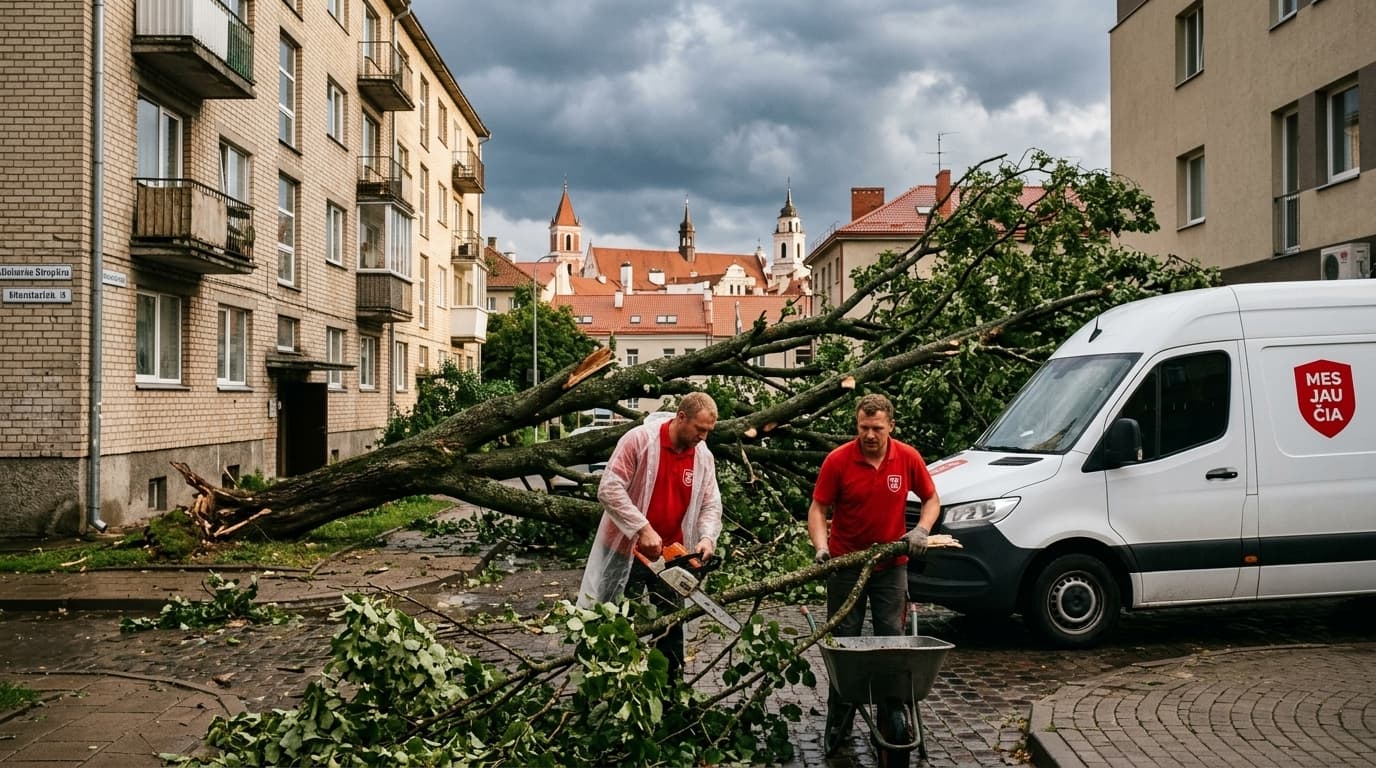
On Thursday evening, a storm swept across Lithuania, forcing firefighters to respond to several dozen call-outs within just a couple of hours – most involving trees falling on roads, power lines and cars. About 1,800 residents were left without electricity, with the Lazdijai, Druskininkai, Varėna and Prienai districts hit hardest. If your home or homestead has been affected by a similar scenario, it's essential to know what to do in the first hours and how to protect yourself next time.
In brief:
- Safety first: check power lines, structures and fallen trees before assessing the damage.
- Cutting large fallen trees off a house or car yourself is dangerous – specialist crane equipment is needed.
- If living at home is no longer possible (damaged roof, prolonged power outage), consider temporary relocation with item storage.
- Waste that piles up after a storm – broken furniture, timber, construction debris – is best removed professionally rather than left to accumulate in the yard.
What happened: the storm left its mark across Lithuania
According to the Fire and Rescue Department, around 30 reports were received during the storm, with the number continuing to rise. The most common issue was trees falling onto roads or power lines, with several cases of trees falling directly onto cars. More on the situation can be found at the source.
The southern part of Lithuania was hit hardest – the municipalities of Lazdijai district, Druskininkai, Varėna district and Prienai district. Isolated call-outs were also recorded in the Širvintos and Vilkaviškis districts. At the time, the energy distribution operator's map showed 60 disruptions, with around 1,800 residents left without power.
Simona Dalinkevičiūtė, a meteorologist from the Lithuanian Hydrometeorological Service, warned that similar summer storms will become more frequent in future, and residents and municipalities will need to adapt accordingly. In other words, this event wasn't a one-off coincidence – it's worth preparing in advance so that the damage is less severe next time.
The first hours after the storm: what to do immediately
Once the storm has died down, first check whether there's any danger to life in or around your home. Power lines on the ground, trees leaning over the roof, or cracked structures are all signals to stop any other work immediately.
When to call 112, and when to contact ESO or the local municipality
Call 112 if there is a direct threat to life: a downed power line on the road, a tree hanging dangerously over people or buildings, or risk of fire. If the power is out but there's no visible danger, report it to ESO via their outage map or hotline. For a fallen tree on a municipal road or public area, inform the local council office (seniūnija) – clearing it is usually their responsibility.
How to document damage for insurance
Before touching anything, photograph and film everything – from wide shots to close-ups of the damage. Record the date and time, ideally with a visible sky view or clock in the background. It's better to provide your insurance company with too much material than too little – you won't get a second chance to capture the original state of the damage.
Temporary protective measures
Cover damaged roof sections with a tarpaulin or sturdy plastic sheeting to prevent water damage from spreading inside. Temporarily board up broken windows with plywood or thick cardboard. This isn't a repair – it's simply a way to stop the damage from spreading until specialists arrive.
A tree down on your house or car – when you need professionals
The most common mistake we see in clients after such events is attempting to cut a large trunk themselves with a chainsaw while it's resting on a roof or car. After impact, a tree is often under tension like a spring, and cutting it at the wrong angle can cause it to suddenly shift, injuring someone or causing even greater damage to the building.
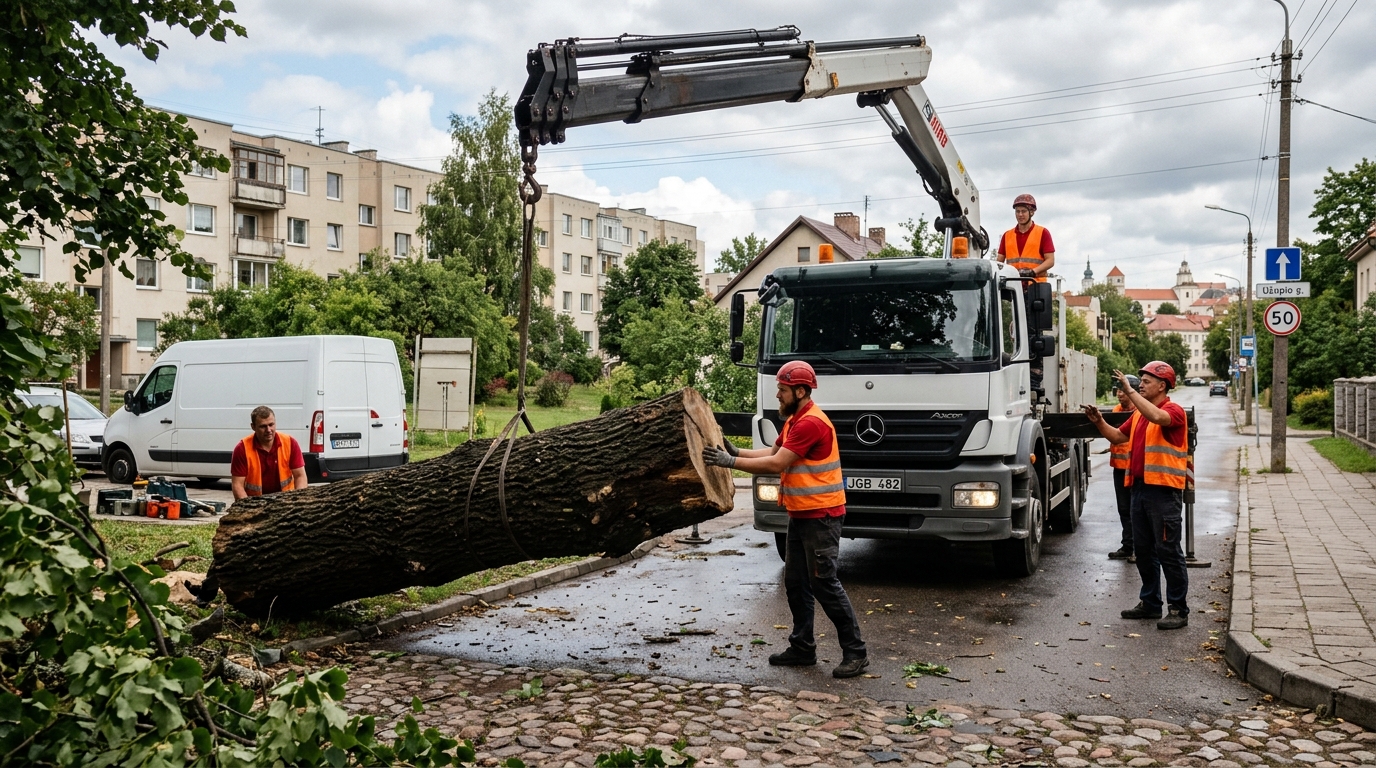
When the trunk is large and resting on a structure – a roof, garage or car – you won't manage without heavy equipment. In such cases, a crane (fiskaras) is needed: the trunk is first lifted and stabilised, and only then safely cut into sections. Trying to do everything by hand often results in additional damage to the roof or wall.
After the cutting work, piles of branches and logs remain that need to go somewhere. This is where fallen tree and timber transport comes in handy – the equipment loads and removes the wood in a single trip, so you don't have to keep piles in the yard for weeks. It's also worth reading about how tree-felling work affects your surroundings and relocation plans, if the damage is significant and you'll need to live elsewhere in the near future.
When living at home is no longer possible: temporary relocation
Sometimes the damage is so severe that staying at home is simply unsafe or impractical – a hole in the roof, power that won't be restored for a long time, damp indoors. In such cases, it's worth seriously considering temporary relocation rather than suffering for a week without heating or with mould risk.
In emergency conditions, items need to be packed quickly but without losing your head – fragile items, documents and electronics first. If the situation is urgent, it's better to call in a team that carries out urgent house removals after an accident – this saves time and reduces the risk of further damaging items in inexperienced hands.
If repairs will take a month or longer, cramming items into a garage or a friend's storage shed isn't worthwhile – it's better to use professional storage while the roof or walls are being repaired. This is especially relevant for furniture and appliances, which could otherwise suffer further damage from damp or construction dust.
How to protect your home and homestead from future storms
Trees and branches
Once a year, ideally in spring, inspect the trees around your house and along the driveway. Dry, cracked branches or those growing too close to the roof are the first candidates to fall during the next strong wind. Plan pruning in advance – don't wait for the tree itself to show you the problem is serious.
Roof, gutters, fences
Before storm season – in May or June – check your roof tiles, gutter fixings and fence posts. Loose tiles or rusted fittings become dangerous flying objects in strong wind.
Insurance and an emergency plan
Property and home insurance against natural disasters is not a luxury – it's a necessity for those living in rural areas or near forests. It's also useful to have a family emergency plan: digital copies of key documents, contact numbers for relatives and services close at hand, and an agreed meeting point in case you need to leave home suddenly. If you live in an area frequently affected by floods or storms, it's worth reading in advance about how to protect a move from storms and floods, so everything runs smoother in an emergency.
After the disaster: managing waste and damaged items
Damaged furniture, soaked appliances, broken window frames – after a major storm, more of these items accumulate than you might expect at first glance. Simply throwing them into the bin outside your house is often impossible due to quantity or size, so separate removal of damaged appliances is needed.
If timber offcuts remain after tree-cutting or roof repairs, it's worth using wood waste removal after a storm – a tidy plot returns your yard to normal much faster. Construction debris – bricks, plasterboard remnants, old insulation pieces – is best entrusted to a team carrying out construction waste removal after renovation.
Letting waste pile up in the yard for a long time causes additional problems – from pests to an unpleasant sight for neighbours and remarks from the municipality. It's better to plan one larger removal straight away rather than dealing with it in parts over several months later.
Frequently asked questions
What should I do first if a tree has fallen on my roof?
First, check that no one is in danger, and don't approach if the tree is resting unstably. If there's a threat to life or to the structure, call 112. Take photos for insurance before starting any clean-up work.
Can I cut a fallen tree off my car myself?
Small trees or branches – yes, if you have experience and the right equipment. Large trunks resting under tension on a car or roof are best left to specialists with crane equipment, as an incorrect cutting angle can cause the tree to move suddenly.
How long can I keep items in storage after a storm?
The duration depends on how long repairs take – some clients use storage for a few weeks, others for several months while the roof or walls are being rebuilt. Contracts are usually flexible, with no strict minimum term.
When is it worth temporarily moving out of your home after a storm?
If the roof is damaged and there's a risk of damp, or if there's no electricity for more than a day or two during winter or a heatwave, temporary relocation is often a safer and more comfortable solution than staying at home. This is especially relevant for families with young children or elderly residents.
How do I calculate the cost of urgent removal or timber transport?
The price depends on the scope of work, distance and equipment required – an hour with two movers and a van costs from €65/hour excluding VAT, with a minimum order of 2 hours. You'll get the most accurate figure by calculating the cost of an urgent move online.
If a storm has damaged your home and you need urgent help – from tree cutting to temporary relocation or waste removal – get in touch for urgent 24/7 assistance or book help online right away.