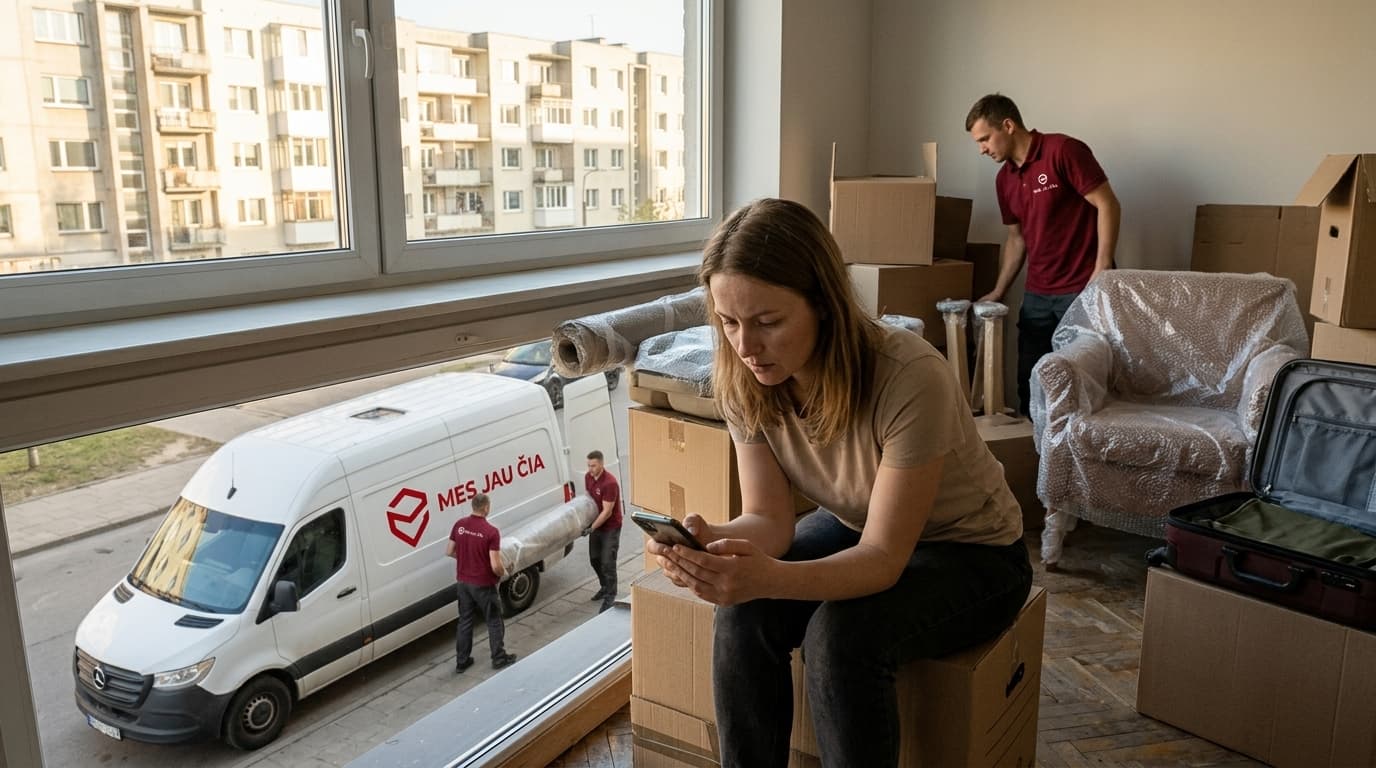
Scammers Are Targeting People Moving House: How to Spot Fraud and Pay Safely
A Vilnius resident received an SMS about an alleged fine, clicked the link, and lost €13,700 within minutes. The Police Department reported this on Monday, and the case was covered by this source. Similar schemes are increasingly being used against people who are simultaneously looking for a rental flat or arranging a house move — a situation involving rush decisions and time pressure, which is a golden opportunity for scammers.
In brief:
- Scammers are increasingly targeting people who are moving house: fake rental listings, fake moving companies, and fabricated SMS messages about "fines" or "parcels."
- The main warning sign is pressure to act immediately, or a request to pay a deposit without a contract or viewing.
- A trustworthy service always has full company details, a price calculator, an official order form, and genuine reviews.
- If you suspect fraud, call your bank immediately, then report it to the police — every minute counts.
What happened: a brief summary of the case reported by 15min
The man received a message imitating an official institution, claiming he had been fined and needed to pay immediately. After clicking the payment window provided in the link, he entered his banking details, and within a short time €13,700 disappeared from his account. This is a classic phishing (or, when sent via SMS, smishing) scenario: fear, time pressure, and a fake but convincing-looking webpage.
This model spreads quickly because scammers target people psychologically — someone who receives a message about a fine or debt reacts emotionally rather than rationally. The same logic applies when moving house: you receive a message about a "delayed shipment" or an "additional transport fee" — and if you are actually expecting a moving service at that time, the link seems entirely plausible.
Why scammers specifically target people moving house and searching for accommodation
The moving period — a week or two — is a time when a person is communicating with several unfamiliar service providers at once: a landlord, a moving company, sometimes also a furniture shop. Decisions are made quickly, often in the evenings after work, when there is no time to look into things carefully.
The second reason is the sums of money involved. A rental deposit, an advance payment to a moving company, payment for furniture transport — these are one-off transfers, often reaching several hundred euros or even a thousand, which don't seem unusual to the person involved. A payment of that size doesn't raise as much suspicion as, say, a request to transfer money to a stranger without any context.
Third is the market itself. There are thousands of rental and moving listings on classified ad sites and social media, and no one has time to actually verify every advertiser.
The most common scams in the moving and rental market
Fake rental listings
The flat is too cheap for the market, the photos are beautiful, and the owner is "currently abroad" and asks for a deposit before a viewing — a classic sign that the listing is fake. A genuine landlord will almost always agree to show the property in person or via video call.
Fake "moving companies"
The listing shows only a phone number and WhatsApp — no legal company name, VAT code, or address. The price offered is significantly lower than market rate, and part of the sum is requested upfront as a "reservation."
Fabricated messages about fines and parcels
An SMS or email about an alleged fine, a payment issue, or a delivery linked to the move — exactly the same scheme described in the 15min article, just adapted to the moving context.
Fraudulent payment links
The link opens a page that visually copies a bank's or courier company's website. The difference is a domain address with one letter changed, or an unusual domain extension (e.g. .info instead of .lt).
How to spot a fraudulent listing or message
- Check the company's official details — legal name, VAT code, years in operation. If these aren't publicly available, that's already a red flag.
- Don't rush to pay a deposit without a contract, invoice, or at least a confirmed order in writing.
- Pay attention to pressure to act "right now" — this is one of the most common tools scammers use.
- Check the link's domain letter by letter — scammers often use nearly identical addresses.
- Genuine service providers have an official website with a calculator, price list, and reviews — not just a phone number in a text message.
We've covered more specific warning signs in our article how to tell a reliable moving team from an unreliable one — worth reading before signing any contract.

How to pay safely when hiring a moving or rental service provider
The safest option is to use an official order form rather than pay via a link sent through Messenger or SMS. For example, an official price calculator with no hidden fees lets you see the real price in advance, while a secure order form with a preliminary price confirms your booking in writing, not just verbally over the phone.
A few rules worth following at all times:
- Only pay after you've received a confirmed order or contract — never before.
- Avoid paying cash without any receipt or invoice.
- Check whether the service is insured — reputable companies state this clearly, not in vague general terms.
- Ask for clear pricing upfront: hourly rate, minimum booking duration, and any additional fees for evening or weekend work.
Indicative pricing in the moving market
| Service | Price |
|---|---|
| 2 movers + van | €65/hour (excl. VAT) |
| Extra mover | +€30/hour |
| Minimum booking | 2 hours (from €130) |
| Evenings, weekends | ×1.5 of base rate |
If the price you're offered via a WhatsApp message is half of what's shown in a similar table, that's not a lucky deal — it's usually an attempt to lure you into paying a deposit.
What to do if you suspect you've fallen victim to fraud
The first step is to call your bank and ask them to stop or reverse the transfer. The faster you do this, the greater the chance of recovering at least part of the money. Then you must report it to the police — as in the 15min case mentioned above, such reports help track scam networks and warn others.
If you clicked the link and entered your login details, change your online banking passwords immediately, even if the money hasn't disappeared yet. You can seek help via your bank's hotline or contact the Lithuanian Police Cybercrime Investigation Division — they accept reports both by phone and online.
How to choose a reliable moving partner and avoid the risk altogether
It's not hard to recognise a trustworthy company if you know what to look for: years in operation, a specific number of reviews, clear pricing published on the website, an official address, and full company details. In our article how to choose a reliable moving service provider, we've compiled a full list of questions worth asking before signing a contract.
The most common mistake we see among clients is agreeing on price and date purely via social media, without any written confirmation. When everything is agreed only verbally on Messenger, it's difficult a week later to prove what was actually agreed and for how much — and if it turns out the "company" doesn't even exist, getting your money back is almost impossible.
We've been operating since 2013, have completed more than 9,500 house moves, have over 500 positive reviews, and all our services are 100% insured. If you're moving into a rented property, you may also find our article on moving into rented accommodation useful, as it also covers related financial risks. You can find out more about our company here, and for those in the Vilnius region, it's worth knowing we provide reliable moving services in Vilnius.
Frequently Asked Questions
How can I recognise scammers pretending to be a moving company?
A genuine company has a legal name, VAT code, address, and an official website with a price list. If a listing only provides a phone number and asks for an upfront deposit without a contract, that's a strong sign of fraud.
Is it safe to pay a deposit to a moving company?
Yes, if the deposit is specified in a confirmed order or contract and paid via an official bank transfer to the company account listed in its official details — not through a link sent in a message or chat.
What should I do if I've already transferred money to scammers?
Call your bank immediately and ask them to stop or reverse the transfer, then report it to the police. If you entered your login details, change your online banking passwords right away.
Why is there so much fraud in rental and moving listings?
Because in these situations people rush to make decisions, handle larger sums of money, and often deal with strangers via classified ad sites or social media, where it's difficult to verify the advertiser.
How can I tell a genuine moving company apart from a fake one in a listing?
Check whether the company has a working website with a calculator, clear pricing, reviews, and full company details. If all communication happens only by phone or WhatsApp, and the price is unusually low, it's worth choosing a different provider.
If you're planning a move and want to know the exact price in advance with no surprises, the easiest option is to check our official price calculator with no hidden fees or go straight to our secure order form with a preliminary price — this way you'll avoid both fraud and unexpected extra charges.